
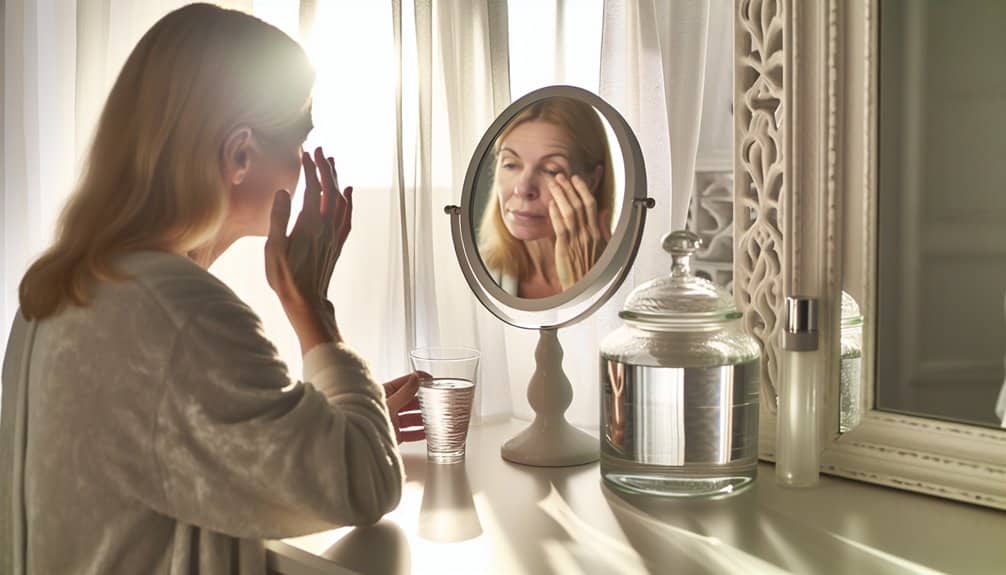
You’ve probably heard that drinking more water keeps your skin “youthful,” but the real connection between hydration and wrinkle prevention is more specific than that. Adequate hydration helps maintain corneocyte integrity, intercellular lipids, and overall skin elasticity, especially around the eyes and mouth. Yet, simply increasing water intake isn’t a magic fix. To understand what actually works—and how to spot when your skin’s starting to lose its hydration advantage—you’ll want to reflect on a few key distinctions…
Key Takeaways
- Adequate hydration plumps corneocytes and supports collagen and elastin, helping skin better resist mechanical stress and form fewer visible fine lines.
- Dehydrated skin exaggerates existing wrinkles and dullness but usually improves quickly with proper water intake and hydrating skincare ingredients.
- Drinking more water modestly improves skin elasticity and smoothness but cannot stop intrinsic aging or replace targeted anti-aging treatments.
- Daily use of humectants and occlusives helps the skin retain water, maintaining a smoother surface and reducing the appearance of fine, dehydration-based lines.
- Sun protection with broad-spectrum SPF 30+ is essential; hydration enhances barrier function but cannot prevent UV-induced collagen breakdown and wrinkle formation on its own.
How Hydration Supports Healthy Skin Structure
A well‑hydrated skin barrier depends on sufficient water within the epidermis and dermis to maintain the structure and function of key components like corneocytes, lipids, collagen, and elastin. When hydration’s adequate, corneocytes remain plump, intercellular lipids stay organized, and enzymatic processes that renew your barrier operate efficiently. This limits microscopic cracking and irritation that can accelerate visible aging.
Hydration also supports collagen production by sustaining fibroblast activity within the dermis. Well‑hydrated fibroblasts synthesize collagen and elastin more effectively, preserving the dermal “scaffolding” that underpins skin elasticity and firmness. Water content further influences the distribution of glycosaminoglycans, such as hyaluronic acid, which bind and hold water in the extracellular matrix. Together, these mechanisms help your skin resist mechanical stress and maintain smoother surface contours. Strategic use of moisturizers that combine occlusives and humectants can further support hydration by reducing transepidermal water loss and reinforcing the skin barrier.
Dehydrated Skin vs. Dry Skin: Why the Difference Matters for Wrinkles
Dry skin is a skin type: you naturally produce less sebum, so your baseline moisture levels and lipid content are low. That can weaken the skin barrier and accelerate visible wrinkle formation over time, especially as the aging process reduces lipids further.
Dehydrated skin is a temporary *condition*: any skin types—including oily—can lack water while still producing oil. Dehydration exaggerates fine lines and dullness but may respond quickly to humectants and barrier-repair products.
Understanding this distinction helps you ignore hydration myths and choose targeted strategies instead of overcorrecting with the wrong products.
What Research Really Says About Water Intake and Skin Aging
When you look past beauty folklore, research on plain water intake and skin aging is surprisingly limited and modest in effect. Studies show that increasing water intake can slightly improve hydration levels, surface smoothness, and skin elasticity, especially if you usually drink very little. But it doesn’t halt the aging process or replace targeted skincare.
Evidence suggests water mainly supports:
- Fine-tuning moisture retention and cellular function beneath the surface
- Assisting the skin barrier so it’s less prone to irritation and dullness
- Supporting skin regeneration alongside sleep, UV protection, and nutrition
- Modulating how diet influence and lifestyle factors show up on your face
- Offering subtle plumping that makes fine lines look briefly softer
Signs You’re Not Drinking Enough for Optimal Skin Health
Instead of working magic, hydration fine-tunes how well your skin can perform its basic jobs—barrier protection, repair, and maintaining a smooth, supple surface—so it helps to know what it looks like when you’re not getting enough. You’ll often see early dehydration symptoms on your face: dull tone, rough or flaky patches, and tightness after cleansing.
A practical test is skin elasticity. Gently pinch the skin on the back of your hand or cheek; if it’s slow to spring back, it’s a sign your tissues aren’t ideally hydrated. Fine lines can look sharper by day’s end, especially around the eyes and mouth, because low water content makes the skin’s surface less plump, exaggerating existing creases rather than causing new ones.
Best Hydrating Drinks and Ingredients for Smoother Skin
Although no single beverage can erase wrinkles, what you drink all day quietly shapes how hydrated, smooth, and resilient your skin looks. You’re aiming to support your skin barrier, dermal collagen, and microcirculation with fluids that deliver water plus electrolytes, polyphenols, amino acids, and healthy fats.
- Clear herbal teas (chamomile, rooibos) for anti‑inflammatory polyphenols
- Coconut water or low‑sugar electrolyte drinks to replace sodium, potassium, and magnesium
- Fruit smoothies with chia seed drinks for fiber, omega‑3s, and vitamin C–rich produce
- Cucumber juice, aloe vera shots, and subtly flavored infused water for low‑calorie hydration
- Collagen‑rich bone broth to supply amino acids like glycine and proline, complementary to topical hydrating masks
Daily Habits to Boost Hydration and Protect Skin Elasticity
To keep your skin hydrated and elastic, you need consistent habits that support moisture both from within and at the surface. Internally, that means matching your fluid intake to your body size, activity level, and environment so your cells maintain ideal water balance. Externally, it means adopting a daily, stepwise skin-moisture ritual—gentle cleansing, targeted humectants, and barrier-strengthening emollients and occlusives—to reduce transepidermal water loss and sustain firmness over time. Incorporating rich, barrier-supporting creams like ceramide-based moisturizers can further lock in hydration and protect against dryness-related fine lines.
Hydrating From the Inside
While serums and moisturizers help from the outside, your skin’s elasticity and wrinkle resistance depend heavily on how well you hydrate from within each day. Adequate fluid intake supports circulation, nutrient delivery, and the collagen–elastin matrix, amplifying hydration benefits and preserving skin elasticity.
Use simple, repeatable cues to keep your cells consistently hydrated:
- A clear glass bottle on your desk, refilled at set times.
- A morning routine where you drink water before coffee.
- A small bowl of water‑rich fruit beside your laptop.
- An herbal tea ritual in the evening instead of a second glass of wine.
- A reminder on your phone linked to meals and short walks.
These habits stabilize internal hydration, reducing dullness and fine-line visibility over time.
Daily Skin-Moisture Rituals
Even with good internal hydration, your skin only maintains elasticity when its outer barrier is cared for through consistent, simple rituals. You’ll want to cleanse with a mild, pH-balanced formula, then apply a humectant serum (like hyaluronic acid or glycerin) onto slightly damp skin to trap water in the stratum corneum. Follow with an emollient and an occlusive moisturizer to reduce transepidermal water loss.
Hydration timing matters: apply your main moisturizer within minutes of washing, and use a richer product at night when barrier repair peaks. Incorporate moisturizing masks 1–3 times weekly; look for ceramides, aloe, and panthenol rather than heavy fragrance. Daily broad-spectrum sunscreen prevents UV-induced collagen breakdown, preserving both hydration levels and wrinkle-resistant elasticity.
Combining Hydration With Skincare for Long-Term Wrinkle Defense
To turn hydration into true wrinkle defense, you’ll need to layer targeted hydrating ingredients—like humectants, emollients, and occlusives—in a way that supports your skin barrier rather than overwhelming it. The most meaningful results occur when this hydration strategy works in tandem with broad-spectrum sun protection, since UV exposure accelerates collagen loss and dehydration. When you apply these steps in a consistent daily routine, you create a stable environment that helps preserve elasticity and reduce the formation of fine lines over time.
Layering Hydrating Ingredients
Although a single hydrating product can help, layering complementary ingredients creates a more durable moisture barrier that supports long‑term wrinkle prevention. You’re not just stacking products; you’re using deliberate layering techniques and clinically supported ingredient combinations to target different levels of the skin.
Think of it as building a hydration scaffold:
- A mist or essence adds a thin, aqueous base so humectants bind more water.
- A hyaluronic acid serum draws and retains moisture within the stratum corneum.
- A glycerin- or urea-rich serum reinforces water-binding capacity.
- A ceramide or cholesterol moisturizer repairs barrier lipids, reducing transepidermal water loss.
- An occlusive balm (like petrolatum) seals everything in at night.
This structured sequence keeps skin plumper, smoother, and less prone to fine-line formation.
Synergy With Sun Protection
While hydration helps keep skin supple and resilient, it won’t meaningfully prevent wrinkles unless it’s paired with consistent sun protection. Hydration benefits focus on barrier integrity, elasticity, and short-term plumpness, but UV radiation drives collagen breakdown, elastin damage, and pigment change—core features of photoaging.
You get the strongest wrinkle defense when you pair humectants and emollients with broad-spectrum SPF 30 or higher. Well-hydrated skin maintains a more intact stratum corneum, which can improve the evenness and adherence of sunscreen, reducing application gaps. In turn, sun protection limits UV-induced dehydration, barrier disruption, and oxidative stress that would otherwise undo hydration benefits. Think of hydration as optimizing skin quality, while sunscreen controls the primary external driver of structural aging.
Daily Routine Consistency
Even with the best products, wrinkle prevention depends far more on what you do every day than on any single “hero” ingredient. Your skin responds to consistent inputs: steady internal hydration, a gentle cleanser, a proven moisturizer, and daily sunscreen. Irregular care—skipping water, neglecting SPF, or over-exfoliating—disrupts the skin barrier and undermines collagen over time.
Use simple hydration reminders and habit-stacking to overcome consistency challenges: pair water intake with meals, and skincare with fixed anchors like brushing your teeth.
- A glass of water at your bedside each morning
- A serum bottle next to your toothbrush
- A phone alarm labeled “SPF + water break”
- A reusable water bottle at your workstation
- Night moisturizer on your pillow-side table

Add Comment