
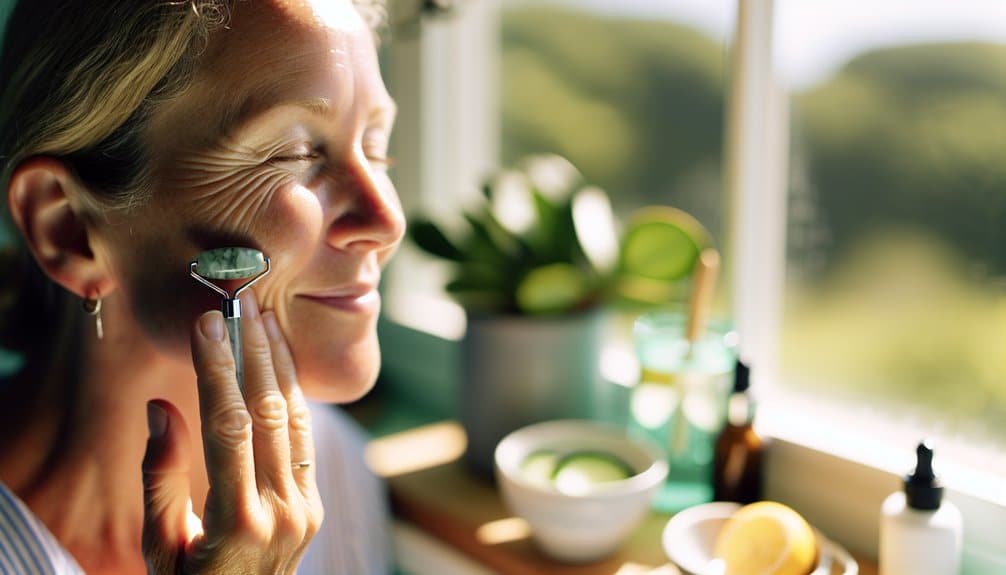
As you age, your skin renews more slowly, your pigment cells behave less predictably, and your collagen support steadily declines, all of which reduce brightness. You start to notice uneven tone, lingering marks from breakouts, and a generally dull surface. Yet many of these changes are modifiable with the right daily habits, targeted ingredients, and timing—and that’s where a strategic, evidence-based approach becomes essential.
Key Takeaways
- Protect skin daily with broad-spectrum SPF 30+, reapplying every two hours outdoors and using hats and sunglasses to minimize UV-induced dullness and discoloration.
- Use a gentle, low-pH cleanser and regular mild exfoliation to remove dull surface cells without stripping the skin barrier.
- Incorporate brightening and reparative ingredients like vitamin C, niacinamide, retinol, and antioxidants to improve tone, texture, and radiance.
- Support skin from within with antioxidant-rich foods, adequate protein, omega-3 fats, and proper hydration to maintain collagen and glow.
- Prioritize 7–9 hours of quality sleep and manage stress through mindfulness and exercise to reduce inflammation and preserve luminosity.
Understanding Why Skin Loses Its Glow Over Time
As the years go by, your skin’s diminished glow isn’t accidental—it reflects predictable biological and environmental changes at the cellular level. Intrinsically, fibroblasts produce less collagen, elastin, and hyaluronic acid, so your dermis thins and reflects light less efficiently. Keratinocytes migrate more slowly, so skin cell turnover decelerates, leaving dull, compacted corneocytes at the surface. Simultaneously, cumulative environmental factors—UV radiation, pollution, tobacco smoke, and metabolic stress—generate reactive oxygen species that damage DNA, proteins, and lipids. This accelerates pigment irregularities, micro-inflammation, and barrier disruption, all of which scatter light rather than allowing even reflection. Vascular changes and reduced microcirculation further limit nutrient and oxygen delivery, so your complexion appears sallow, uneven, and less luminous over time. At the same time, marketing for anti-aging products often promotes unrealistic expectations with misleading health claims that are not backed by solid clinical evidence.
Daily Habits That Help Preserve Radiance
To maintain skin brightness as you age, your daily habits matter as much as any targeted treatment. Gentle daily cleansing, consistent sun protection, and a hydrating skincare routine collectively support barrier function, limit UV-induced oxidative damage, and optimize light reflection from the skin’s surface. By systematizing these practices, you create a stable environment in which your skin can maintain radiance despite intrinsic and extrinsic aging factors. You can further support these efforts by exploring anti-aging skin care and supplements from established brands that focus on quality and effectiveness.
Gentle Daily Cleansing
While potent serums and devices often get the spotlight, daily cleansing is the quiet step that most determines whether your skin looks clear or dull. You’re removing oxidized sebum, pollution particles, and sweat that drive inflammation and uneven tone when they sit on skin.
Choose low‑pH, non‑foaming formulas with clinically tested surfactants that cleanse without stripping lipids. Look for natural cleansing ingredients like glycerin, colloidal oatmeal, or aloe, which support barrier function.
Use gentle exfoliation methods no more than a few times per week—such as low‑strength lactic acid or a soft washcloth—to reduce dull, compacted cells without micro‑tearing.
| Goal | Evidence‑based choice |
|---|---|
| Remove debris | Mild, sulfate‑free cleanser |
| Support barrier | Ceramides, glycerin |
| Minimize irritation | Fragrance‑free formulas |
| Reduce dullness | Controlled chemical exfoliants |
| Maintain hydration | Short, lukewarm cleansing routines |
Consistent Sun Protection
Even the most sophisticated brightening routine can’t overcome unprotected UV exposure, which is the primary driver of uneven tone, hyperpigmentation, and loss of luminosity. To protect brightness, you need daily, year-round sunscreen application, not just on sunny days. Dermatologic data show that up to 80% of facial aging signs are attributable to cumulative UV exposure, including through clouds and window glass.
Use a broad-spectrum SPF 30 or higher on all exposed skin every morning, applying about a nickel-sized amount for the face and more for neck and chest. Reapply every two hours with sustained outdoor exposure. Complement this with UV-blocking behaviors: shade-seeking, wide-brimmed hats, and UV-filtering sunglasses. Consistency here directly preserves clarity, uniform tone, and light-reflective smoothness.
Hydrating Skincare Routine
Although pigment often gets the most attention, adequate hydration is just as critical for maintaining a bright, light-reflective complexion as you age. Well-hydrated skin scatters light more evenly, softens fine lines, and stabilizes the skin barrier, reducing dullness and irritation. You’ll benefit most from strategic hydration techniques that target both water content and lipid integrity.
Use “moisture layering” to optimize absorption: apply a humectant serum on damp skin, seal with an emollient, then lock in with an occlusive if needed. Choose fragrance-free, alcohol-free formulas to limit barrier disruption.
| Step | Product Type | Clinical Purpose |
|---|---|---|
| 1 | Gentle cleanser | Preserve barrier lipids |
| 2 | Hydrating mist/toner | Replenish water, prep penetration |
| 3 | Humectant serum | Bind water in the epidermis |
| 4 | Emollient cream | Smooth, fill micro-fissures |
| 5 | Occlusive (optional) | Reduce transepidermal water loss |
Essential Skincare Ingredients for Bright, Even Tone
A strategic approach to ingredients is what truly determines how bright and even your skin can look over time. When you target pigmentation and dullness directly, you improve both radiance and prevention.
Vitamin C is a gold-standard brightener, reducing oxidative stress and interfering with excess melanin formation. Niacinamide supports an even tone by slowing pigment transfer while reinforcing the Skin Barrier. Alpha Arbutin and Licorice Extract act on key steps in melanogenesis, helping fade dark spots with relatively low irritation risk.
Retinol benefits include accelerated cell turnover and enhanced collagen production, which improve texture and luminosity. Exfoliating Acids (AHAs, BHAs, PHAs) refine surface pigment and boost light reflection. Prioritizing Antioxidant Richness across your routine further limits future discoloration.
Building an Age-Appropriate Brightening Routine
Because skin physiology and pigment behavior change over time, an effective brightening routine has to be tailored to your decade of life, not just your concerns. In your 20s, prioritize barrier-friendly cleansing and a single brightening active at low strength. By your 30s–40s, you’ll usually benefit from customized serums that layer tyrosinase inhibitors with gentle exfoliants on alternating nights. In your 50s and beyond, integrate richer textures and peptides to counter thinning skin while maintaining pigment control.
| Decade Focus | Core Brightening Steps |
|---|---|
| 20s | Mild cleanser, antioxidant serum, single brightener |
| 30s–40s | Customized serums, alternating exfoliation, hydration |
| 50s+ | Barrier repair, multi-target brighteners, peptides |
Plan seasonal adjustments: lighter gel textures and reduced exfoliation in summer; more emollients and slightly stronger actives in winter.
Sun Protection Strategies to Prevent Dullness
No brightening routine can outperform daily UV protection, since even low-grade sun exposure accelerates pigment clustering, collagen loss, and surface roughness that all read as dullness. You’re not just preventing burns; you’re preserving optical clarity, tone uniformity, and light reflection.
- Daily sunscreen application (broad-spectrum SPF 30 or higher) shields you from UVA-driven pigment and collagen damage, not only “vacation sun.”
- Reapply every 2 hours outdoors, and after sweating or swimming, so cumulative UV protection actually matches what clinical studies assume.
- Use physical barriers—wide-brimmed hats, UV-blocking sunglasses, tightly woven clothing—to reduce exposure beyond what any formula can manage.
- Seek shade between 10 a.m. and 4 p.m.; this single habit markedly lowers long-term dullness and uneven tone.
Professional Treatments That Boost Luminosity
While daily skincare and sun protection form the foundation of brightness, professional treatments can strategically target stubborn dullness, pigment, and textural change that topical products can’t fully correct. You’ll see the clearest payoff when a dermatologist customizes a plan to your skin type, tone, and medical history.
| Treatment Type | Primary Luminosity Targets |
|---|---|
| Microdermabrasion | Enhances radiance, refines rough texture |
| Light–medium chemical peels | Evens tone, boosts glow with minimal downtime |
| Laser / IPL | Reduces brown spots, redness, mottled pigmentation |
| Resurfacing lasers / microneedling | Improves fine lines, texture, light reflection |
Understanding microdermabrasion benefits helps you set realistic expectations: it’s best for superficial dullness, not deep wrinkles or significant sun damage. Evidence‑based chemical peel options (glycolic, lactic, salicylic, TCA) can be adjusted in strength and frequency to gradually restore clarity and luminosity.
Lifestyle Choices That Reflect on Your Skin
As you age, your daily habits can either support or undermine the skin’s natural radiance. Evidence consistently links nutrient-dense eating patterns, adequate and high-quality sleep, and effective stress regulation with improved barrier function, more even tone, and better luminosity. By optimizing nutrition, sleep, and stress management, you create the internal conditions your skin needs to renew efficiently and maintain brightness. In addition, regularly using well-chosen moisturizing products can help support the skin barrier, reduce dryness, and maintain a smoother, more luminous appearance over time.
Nutrition for Luminous Skin
Although topical products play an important role in skin care, the nutrients you consume have a direct, measurable impact on brightness, texture, and resilience. What you eat and drink continuously shapes collagen integrity, pigmentation patterns, and inflammatory activity in your skin.
- Prioritize antioxidant rich foods (berries, citrus, leafy greens). They neutralize free radicals that accelerate dullness, pigment irregularities, and fine lines.
- Choose hydration boosting beverages such as water, unsweetened green tea, and herbal infusions; they support ideal dermal hydration and microcirculation.
- Include omega‑3 fats (fatty fish, flax, walnuts) to reduce inflammation that can cloud radiance and disrupt barrier function.
- Emphasize lean protein (eggs, poultry, legumes) to supply amino acids required for collagen, elastin, and keratin, preserving firmness and a luminous surface.
Sleep and Skin Renewal
Even a modest improvement in your sleep quality can measurably change how your skin looks and repairs itself. During deep non-REM sleep, your body increases blood flow to the dermis, boosts growth hormone release, and accelerates skin regeneration, including collagen synthesis and DNA repair.
When you cut sleep short, inflammatory markers rise and your skin barrier weakens, making fine lines, dullness, and uneven tone more visible. Aim for 7–9 hours of consistent, uninterrupted sleep; irregular schedules disrupt circadian rhythms that coordinate nighttime repair.
To support ideal skin regeneration, keep your bedroom dark, cool, and quiet, avoid heavy meals, alcohol, and nicotine near bedtime, and limit screens for at least 60 minutes before sleep to reduce blue-light–mediated circadian disruption.
Stress Management for Glow
Quality sleep isn’t the only rhythm your skin responds to; your stress patterns leave clear fingerprints on brightness and texture too. Chronic stress raises cortisol, which breaks down collagen, disrupts skin-barrier lipids, and increases inflammation, leading to dullness, sensitivity, and more pronounced lines. You can’t eliminate stress, but you can regulate your response.
- Reclaim 10 quiet minutes daily for mindfulness practices; research shows reduced cortisol and improved skin-barrier recovery.
- Prioritize consistent movement—brisk walking or strength work enhances circulation, delivering oxygen and nutrients that restore radiance.
- Set digital boundaries at night; decreased blue-light and mental load support hormonal balance and visible skin calm.
- Use stress relief rituals—slow breathing, brief stretching, journaling—to interrupt tension cycles that otherwise show up as flare‑ups and fatigue in your skin.


Add Comment