
The Telomere Connection 🧬
CWhealth is led by Eva and Dr. Rowell (MedicalHat), a compassionate duo blending clinical insight with a passion for practical wellness.
Dr. Rowell, a retired physician trained and practiced in the Philippines, now channels his medical experience into developing accessible anti-aging strategies and tools. Eva, a registered nurse currently working at the Eye and Ear Hospital in Melbourne, brings frontline healthcare knowledge and a nurturing touch to everything CWhealth creates.
Together, they’re on a mission to make science-backed wellness simple, relatable, and empowering for every stage of life.
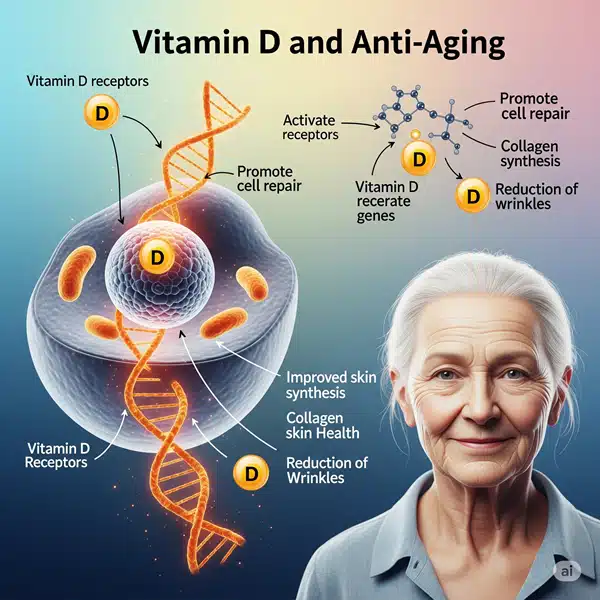
Could your daily dose of sunshine be doing more than just lifting your mood? Recent research suggests that vitamin D may play a role in slowing biological aging, offering new hope for those seeking simple, science-backed ways to support longevity.
At the heart of this discovery lies telomeres — protective caps at the ends of chromosomes that shorten as we age. Shortened telomeres are linked to age-related diseases like cancer, cardiovascular conditions, and neurodegeneration.
A groundbreaking sub-study from the VITAL trial, published in The American Journal of Clinical Nutrition, tracked over 1,000 participants for four years. Researchers found that daily supplementation of vitamin D3 (2,000 IU) significantly reduced telomere shortening compared to a placebo — the equivalent of preventing nearly three years of biological aging.
🔍 Key Findings
- Study Design: Randomized, double-blind, placebo-controlled trial
- Participants: Adults aged 50+ (men) and 55+ (women)
- Duration: 5 years
- Result: Vitamin D group lost 140 fewer DNA base pairs in telomeres over four years
- Omega-3s: No significant effect on telomere length
Dr. JoAnn Manson, principal investigator of the VITAL study, noted that this is the first large-scale trial to show vitamin D’s protective effect on telomeres. Co-author Dr. Haidong Zhu added that targeted supplementation “may be a promising strategy to counter biological aging”.
⚠️ What Experts Are Saying
While the findings are promising, experts urge caution. Dr. Marilyn Tan of Stanford University points out that the study focused only on telomeres in white blood cells and didn’t assess broader health outcomes. Dr. David Cutler adds that lifestyle factors like exercise, sleep, and stress management remain the most reliable ways to preserve telomere length.
🥛 How to Boost Your Vitamin D
- Sunlight: 10–30 minutes of midday sun exposure
- Foods: Salmon, tuna, egg yolks, fortified milk
- Supplements: Consult your healthcare provider before starting
🧠 Final Thoughts
Vitamin D has long been known for its role in bone health and immune support. Now, with emerging evidence linking it to cellular aging, it may become a key player in preventive medicine. While more research is needed, this simple nutrient could be part of a broader strategy to age gracefully — from the inside out.
Sources:
Manson, J.E., et al. (2025). Vitamin D supplementation and telomere length: findings from the VITAL study. The American Journal of Clinical Nutrition.
News coverage via Nexstar Media/Fortune, “Vitamin D may slow biological aging,” July 2025.



Add Comment